Choose a paper bag to fit the product as it will be handed to the customer, including its box and wrapping. Measure the packed width, depth and height, allow room for loading and removal, and check that the contents leave enough space to grip the handles comfortably. A size name such as “medium” cannot tell you whether your gift box will fit.

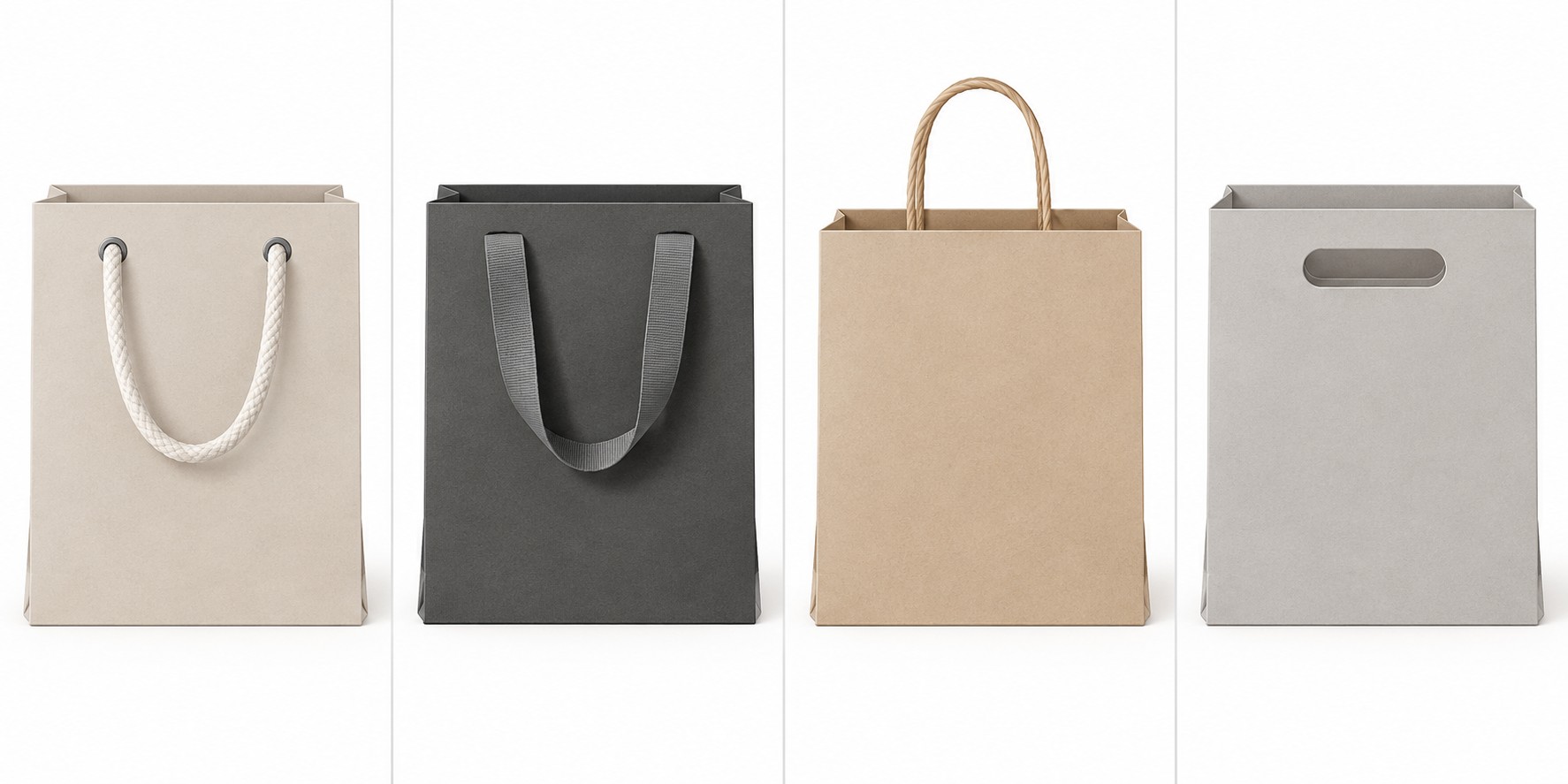
Paper bags with side gussets and cotton rope handles.
Measure the fully packed product
Start with a typical order. If you sell a scarf in a presentation box, measure the closed box rather than the scarf. Include tissue, protective wrapping and any components that must travel inside the bag. For several items, arrange them in the position staff will actually pack them before taking measurements.
Write down the arrangement as well as the numbers. Two boxes stacked vertically produce a different requirement from the same boxes placed side by side. Keep a photograph with the measurements so the supplier can see the intended orientation.
For flexible items such as folded clothing, use a consistent folding method. A bag sized for a tightly compressed sample may be awkward to fill at checkout. Try the arrangement that staff can repeat during normal service.
Describe width, gusset depth and body height separately
For a shopping bag with side gussets, label the front width, full gusset depth and body height on the same drawing.
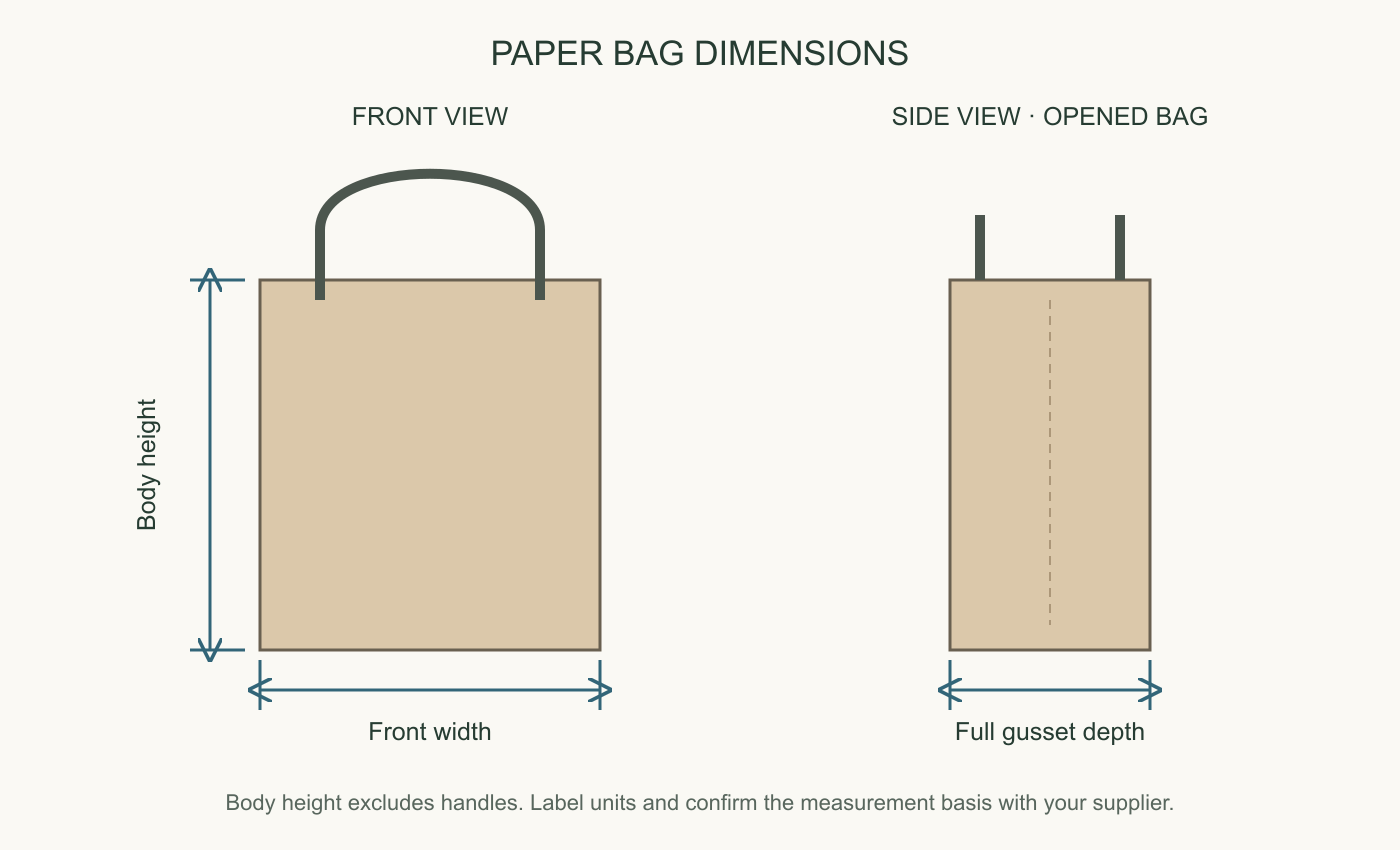
Measure the full side depth with the bag opened. Body height excludes the handles.
| Measurement | What it describes | A mistake to avoid |
|---|---|---|
| Front width | The span across the front face of the opened bag | Assuming every supplier calls this length |
| Gusset depth | The full distance from front to back when the side is opened | Measuring only half of the folded gusset |
| Bag body height | The distance from the base to the top edge of the paper body | Including the handle without saying so |
Use a drawing or annotated photograph and state the units. Suppliers may use different letter conventions, so “W × D × H” is only helpful when both parties agree which side each letter identifies. If you need usable internal space or a specific external size, say that explicitly.
When checking an existing bag, open it into its normal shape without stretching the paper. Record its construction and whether you measured inside or outside. If you send an existing bag as a reference, ask the supplier to confirm the usable internal dimensions of the proposed replacement.
Allow room for loading and removal
Extra space has a purpose: it lets staff load the product and customers remove it. Too little can make a rigid box catch against the opening; too much can allow contents to shift or make the bag look oversized.
Do not apply one clearance allowance to every product. Compare the proposed size with your actual packed contents and ask these questions:
- Can the largest intended item pass through the opening without bending the bag or scraping its finish?
- Can staff lower it into position while keeping the wrapping tidy?
- Can the customer reach inside and lift it out?
- Does the arrangement remain practical when more than one item is packed?
For example, if your shop sells both a single boxed item and a two-box gift set, try each arrangement in the proposed bags. One larger size may cover both, but check that the single-item order is still easy to carry and does not look lost inside it.
Check height together with the handle
A box may fit below the top edge yet interfere with the customer's fingers or the handle attachment. Check the top of the packed contents with the handles held as they will be carried. For a die-cut handle, make sure the product leaves the hand opening usable.
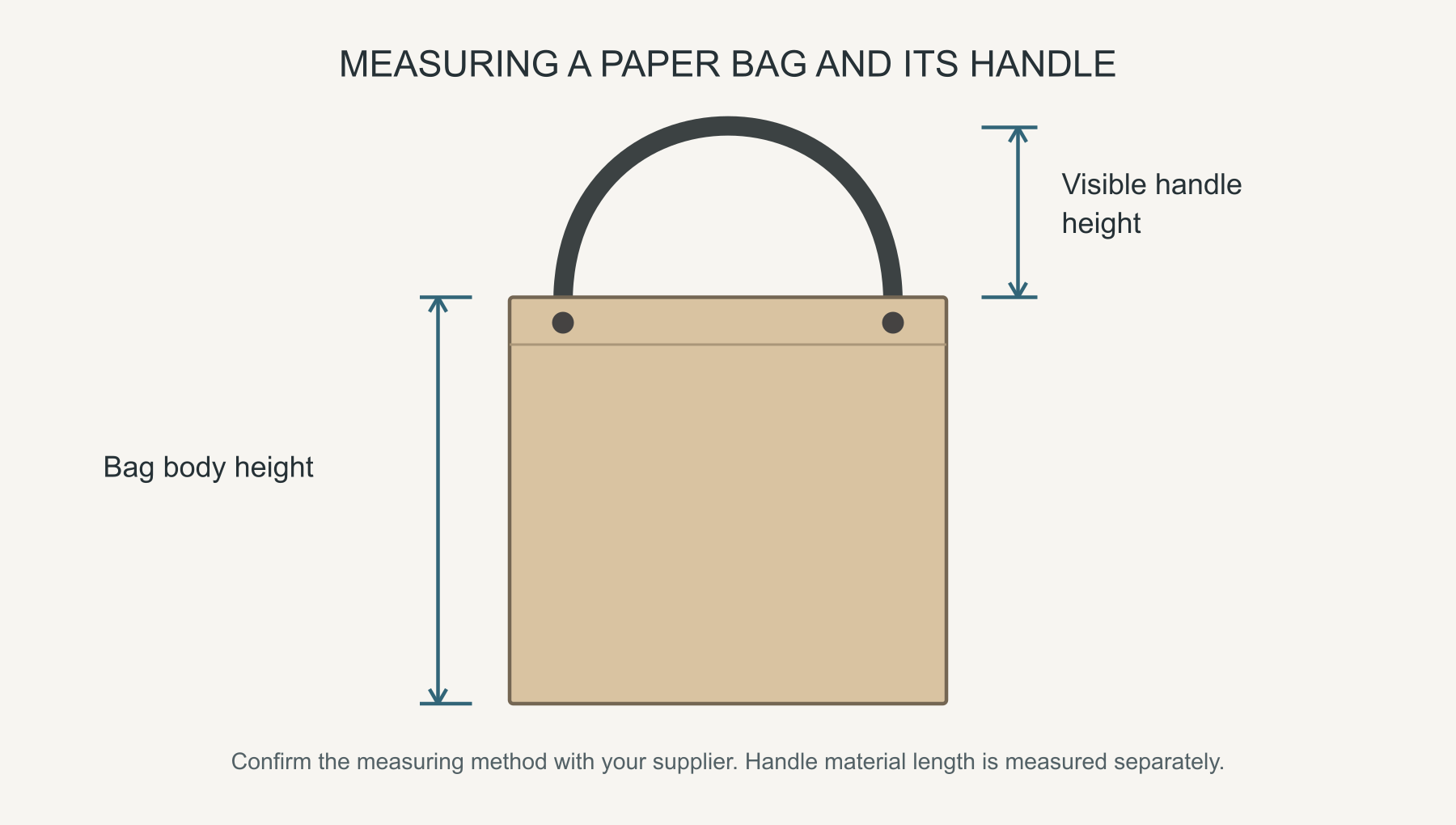
Specify bag body height and handle height separately.
If a supplier asks for handle length, establish whether that means the material length or the visible height after attachment. Our paper bag handle guide explains the choice of handle style and what to check on a sample.
Decide whether one bag size is enough
Use your actual product range to decide how many sizes to order. A small size range can simplify packing, but only if it works for the purchases customers make.
| Purchase pattern | What to compare | What would justify another size |
|---|---|---|
| Mostly one boxed product | Candidate bags around the closed box | The available size is difficult to load or visibly oversized |
| Frequent multi-item purchases | The most common combinations | Stacking or side-by-side packing changes the space needed substantially |
| A mix of soft goods and rigid gift boxes | Repeatable folds and closed-box dimensions | One format consistently compromises packing or carrying |
Before allocating quantities to each size, list the orders each bag will accommodate. This gives your purchasing and store teams a common basis for discussing the size range.
Approve the sample with a written record
Use the actual bag construction and intended contents for the fit review. Record the bag measurements and measurement basis, the product arrangement and the packed weight. Note whether loading, removal and grip are satisfactory, and photograph any problems.
Check carrying performance separately from fit. A bag that fits the box may not be suitable for its weight. Give the supplier the total packed weight and agree how the finished bag will be evaluated before approving it.
Send the supplier your packed-item dimensions, arrangement photographs, preferred handle, quantity, destination and desired delivery date if known. You can start with our black cotton-rope paper bags, then discuss the dimensions for your own purchase combinations.
A size brief you can send with your enquiry
Use labelled measurements rather than sending three numbers on their own. You can adapt this wording:
We need a shopping bag for a closed gift box measuring [front width] × [depth] × [height] mm. Each bag will contain [item count and arrangement], with a total packed weight of [weight] kg. Please recommend a bag size with room for loading and removal, and confirm whether your quoted dimensions are internal or external. We prefer [handle style] for [hand, wrist or shoulder] carrying. Photos of the packed items are attached.
The dimensions in this brief describe the contents, not the final bag. If an item size or weight is still unknown, say so and arrange to confirm it before approving the sample.
Frequently asked questions
Does paper bag height include the handles?
In this guide, body height excludes the handles. State that convention in your brief and label any overall height separately; do not assume every quotation uses the same notation.
Can I choose a bag from the product's dimensions alone?
Use the dimensions of the complete packed purchase. Inner boxes, wrapping, item orientation and loading access can change the space required.
Is a larger bag stronger?
Size alone does not establish carrying capacity. Review paper, handles, attachments and base construction against the intended contents and any agreed performance requirement.
Should I copy the size of an existing shopping bag?
You can use it as a reference if it works for your products. Provide labelled measurements and a sample or photographs, then check the proposed replacement with your contents before approving production.